
Der Ring des Nibelungen

| Richard Armstrong | |||||
| Scottish National Chorus and Opera Orchestra | ||||||
Date/Location
Recording Type
|

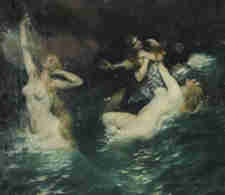
Das Rheingold |
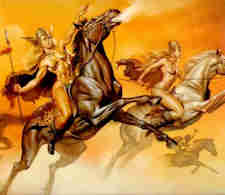
Die Walküre |
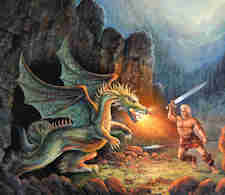
Siegfried |

Götterdämmerung |


Who likes Wagner? I mean, apart from Francis Ford Coppola who used The Ride of the Valkyries to grant shocking grace to the helicopter sequence in Apocalypse Now. Well, not me.
My exception is Tristan und Isolde which I saw at the precocious but impressionable age of 14 but, as I said last year, if I ever hear Parsifal again it will be too soon. So imagine my feelings when, at the end of a spellbinding Prom blisteringly well conducted by Claudio Abbado the conductor turned to us and announced an encore: the Vorspiel to Parsifal. Five minutes later, I was stunned to realise that tears were rolling down my face.
That’s why, a year later, I nervously agreed to attend not one Wagner opera but four, ie Scottish Opera’s Ring Cycle. Thanks to my Prom epiphany I was now willing to face 15 hours of music across four nights because I’d succumbed to the raw emotion of his orchestral writing. But what if this were the only way I liked Wagner: no singing, no story, no ideas? Ah, ideas. I’d mentioned my epiphany to a musician friend. “You’re not one of those people who can’t separate Wagner’s music and his ideas are you?” he enquired, suspiciously. Well, pardon me for seeming jejune, but no I can’t.
Neither could Wagner. Shakespeare’s politics and personality are, in spite of earnest attempts by the BBC’s Michael Wood, untraceable from the plays. Philip Larkin’s private racism only indirectly affects his public poetry because the two remained separate. But Wagner’s fingerprints are all over his work. To an unprecedented degree, his music and ideas are indivisible. This man published an outspoken 750-page autobiography and a staggering 15 volumes of musical and political philosophy, including the notorious and staunchly negative book on Jewishness and music. As a half-German and wholly Jewish man I find that complicates matters. And the real complication is that all that found its most profound expression in his musically, dramatically and intellectually ground-breaking operas, especially in the study of power and authority which was his masterpiece, The Ring, 26 years in the making.
So, by the first night, I was feeling torn. This marathon repays preparation so I’d investigated its hundreds of themes depicting and developing characters, symbols, events and emotions. Further reassured by being able to stick closely to events thanks to surtitles, I thought I was prepared. I wasn’t. Nothing could have prepared me for the fact that when the final curtain fell, I was among those yelling in astonished joy.
Five years in the making, this resplendent production was masterminded by Scottish Opera’s conductor Richard Armstrong whose control and vigorous encouragement of the gigantic 101-strong orchestra produced extraordinarily subtle results. I’ve never noticed the delicious woodwind writing usually buried beneath the blasting brass in The Ride of the Valkyries. Climaxes were splendrous but the singers were rarely swamped beneath the orchestra. Better yet, and this is the real test, the entire cast looked both dramatically engaged (a terrifyingly rare event in most Wagner productions) and engagingly relaxed. Why? Because they were in a seriously imaginative, properly detailed production.
Director Tim Albery and designer Hildegard Bechtler pay the works the ultimate compliment of pointing up their universality by not trapping them within a specific conceit. They lassoo the audience by making it use its imagination. Bechtler’s ravishingly beautiful designs use giant, abstract, curving set pieces to carve spaces which simultaneously shield and define the characters. Across successive evenings, she and Albery cunningly shift the style from mythic to modern, from lateral to literal. They make characters evolve from the archetypes of Das Rheingold to contemporary people in Götterdämmerung.
Siegfried, the least dramatic of the four, has problems, not helped by young and valiant Graham Sanders struggling in the fiendishly hard title role. Lounging around with the slouch of a sloppy, stroppy teenager, he can’t yet support his voice through this killer role which demands unbelievably high, strong singing across two entire nights. Unluckily for him, he’s paired against a spectacular Brünnhilde.
Lean as a whippet in trim black trousers, Elizabeth Byrne looks like a cross between the young Liza Minnelli and Keeley Hawes. The only enormous things about her are the power of her perfectly focused voice and the career she’s going to have.
Former Swedish popstar Jan Khyle sings Siegmund. His spine-melting voice is both powerful and immensely lyrical and Albery capitalises upon his talent and rippling physique and stages the first act of Die Walküre with astonishingly well-played eroticism. When the brother and sister seal their love with a passionate kiss, Albery pulls off a real coup by pulling the chairs and tables from under them.
Khyle’s talent is matched by Matthew Best’s Wotan, a richly sonorous bass of ever-increasing gravitas, Mats Almgren’s stunningly still and malevolent Hagen and, best of all, Alasdair Elliott’s Mime. Looking for all the world like Harry Hill in baggy leather shorts, the expressiveness of his magnificently penetrating singing is equalled only by the engrossing detail of his acting. Watching him gleefully whip up poison with an egg-beater is one of endless tiny, terrific moments.
Siegfried marks the only change in this self-evidently harmonius creative team. Peter Mumford’s revelatory (in every sense) lighting for this and Götterdämmerung brings everything into sharper focus. Mumford made his name bathing dancers in scalding side-light and is, literally, brilliant at colouring and controlling emotions in large spaces. Bechtler cunningly highlights the production’s controlling image of a journey by using an increasingly raked white road surrounded by massive, dark, leaning walls and Mumford makes the petrol blue on the set simply gleam and splashes acid greens and scorching yellows against a bald Beckettian tree. By the end of the act the music is in major keys and his palette has turned to super-saturated purple and gold. The whole design team make you see what Wagner meant when he wrote that his operas were “acts of music made visible”.
Scottish Opera, currently lurching between funding crises, should brandish this magnificent achievement before every funder or sponsor in the world. As for me, unlike Siegmund, I didn’t fall headlong in love. I’ve abandoned many of my Wagner prejudices but I’m still nervous about the solipsism of his vision. But give me a chance to see this mind-blowing production again and I’d be there like a shot.
David Benedict | 24 August 2003
Going for gold
Scottish Opera’s production at Edinburgh Festival Theatre follows common practice in making this nearly a week, for the vocal demands are so great that the singers must rest between the main dramas. It is a demanding experience for the audience, too: to sit still for the 180 minutes of Das Rheingold or the two hours till Götterdämmerung’s first interval is not easy, and one never knows what distractions are in store: a watch alarm went off twice behind me as the Three Norns spun the rope of time, and it was hard to internalise Wotan’s Farewell with a man vigorously chewing in front of me.
Yet, in a sense, The Ring comprehends and transcends such contingencies. Consisting as it does of a vast network of leitmotifs — themes or figures that are in flux, altering their meaning as they recur — the work underscores the provisionality of the present moment while suggesting there is always something to be made of it. The Ring is all about moving forward, striving for something superb and complete that cannot, however, be found. Even the last bars — the transcendent D flat chord that sees off the corrupt reign of the “immortal” gods and ushers in humanity’s realm of love — have a provisional aspect.
They are not, after all, a return to the E flat in which Das Rheingold so oceanically begins. The ring that the Nibelung stole may have been restored to the Rhinemaidens, but we have not returned to such innocence. We are in another place, and one could say that the 15 hours have simply been about moving us that distance of a tone: E flat to D flat. Wagner’s tonality is progressive; he does not return to his source, and no more do the motifs achieve “definitive” form. I was struck anew by how the very appearance of one makes you hanker for a fuller version, and how one never seems on stable musical ground. The strain of raising the edifice that is The Ring can be felt at every moment.
This contingent quality, though intensely moving, means that the work can no more have a wholly satisfying performance than it can have a wholly undistracting audience. It cannot be fixed on stage for it is constantly experimental; and as with an epic poem, its longueurs and inconsistencies are part of a gigantic ambition that leaves notions of perfection and good taste far behind. A production need not worry about these, but there is little danger of that nowadays. We are lucky if Ring reinterpretation leaves room for telling the story. One thing that can be said for Tim Albery’s low-budget staging is that (helped by crisp surtitles) it does that very nicely.
You always know where you are, even if it is a place less grand than you expected. The great confrontations in Die Walküre’s Act II happen on or around a motorway with broken stanchions; the Dragon’s cave has a convenient street light; the Gibichung Hall is in the vicinity of a tower block. Hildegard Bechtler’s sets and Wolfgang Göbbel’s lighting often astonish (the entry of Spring in Die Walküre is a literally golden moment), but Albery is too governed by the bathetic fallacy that says nature will not only not reflect internal states but will studiously contradict them.
Strewn across the production are what might be called his “trite motifs” — shoes, cheap furniture, beer bottles, graffiti — and he skirts, I felt, a kind of inverted misogyny in his relentlessly humorous depiction of the Rhinemaidens (tarts) and Valkyries (tomboys). It is funny, but in the wrong way for Wagner, and fatally distracts from the music. Albery’s is less an interpretation than a confession of embarrassment at Wagnerian theatre. Brünnhilde’s self-sacrifice on a gas ring is the final irritation.
But the cuteness matters less when the singing is so generally impressive. Elizabeth Byrne’s young-looking (if oddly bent) Brünnhilde actually gained in strength to carry the final moments with touching dignity. Matthew Best’s Wotan and Peter Sidhom’s Alberich are resonant, nuanced assumptions, the strongest of the singers. Peter Bronder gives an unforgettably wily Loge, Markus Hollop a lugubrious Fafner. But Jan Kyhle as Siegmund did not quite rise to his Winterst ürme song; and Graham Sanders’s blond, cuddly Siegfried had a toneless edge to the voice (deceptive, because he could lay on fortissimi) but lost voice as well as tone by mid-Götterdämmerung, and was unable to make the love scene in his titular drama a success.
The only character to appear in all four dramas is the orchestra. Under Richard Armstrong, it was an expressive one, tonally warm and fat, reliably glowing bronze, reliable altogether. But that became a problem: missing was a level of audacity and risk-taking proper to this music. Armstrong was wise to play safe, but it meant, say, that the Ride of the Valkyries lacked incisiveness (it should slice the air), that the gods’ return from Nibelheim dragged, that Brünnhilde’s annunciation of death to Siegmund was interminable. How awful to carp on! This was one of the memorable weeks of my life.
Paul Driver | August 24 2003
Ringing success
IMAGINE Sleeping Beauty racked out — on a rock — for 20 years, and the prince who kisses her awake turns out to be a proto-Nazi slob in parka and ski-hat. It is the central image of Scottish Opera’s Ring, and one which can daunt the hardiest constitution. In this context, it’s hard to take Siegfried seriously as saviour of the world. In fact, the thought is terrifying. It is the queasiest moment in Tim Albery’s production of Wagner’s cycle.
And then, after a night being mummed up by Brünnhilde, Siegfried emerges with a new suit, hormones tamed and a backslapping affability. And he doesn’t save the world. He unwittingly betrays Brünnhilde, fails to return the ring to the Rhinemaidens, and gets killed.
What Albery has done with notable success is to relocate the drama of the Ring to a place where the mythic and the everyday overlap. This is the most personal, most domestic of stagings, and you are aware that all the characters are part of a large, extended family who take internecine squabbles beyond anything dreamt of by a Dallas scriptwriter. And the character whose actions have most bearing on everyone else is Wotan, a paterfamilias whose journey towards understanding, self-awareness and humanity forms the core of the Ring and lours over even the last instalment, Götterdämmerung, in which he doesn’t appear.
Wotan’s journey towards self-knowledge takes place through conversation. The pivotal work of the four-night drama is the second, Die Walküre, essentially a series of duets in which the gods learn from humans about civilised behaviour. At the start Wotan is still trying to repossess the ring, this time through his human offspring, Siegmund. By the end he sees that the future requires the destruction of himself and all he loves. The other characters are a step behind him, and do not realise he has become a moral being. “I am not stupid, or cowardly,” he says. But no one believes him.
Matthew Best’s performance is a wonder of control, vocal power and dignity, with a profoundly interiorised sense of warring loves. There is a moment in Siegfried where Wotan meets his alter ego, Alberich, the scene evocatively set in some urban wasteland, and for the first time Wotan laughs not entirely cynically. It is a big humanising moment, perhaps the point where Wotan fully realises what is going to happen. And in a very human way he has second thoughts, a moment of vanity when he meets the bumptious Siegfried, his grandson, and doesn’t get the respect he feels he deserves.
This staging is all about moments in which self-love, fear and human sympathy battle for supremacy. Siegfried wakes Brünnhilde and both are terrified: she of losing her godhead, he unmanned by the shock of sexual awakening. Siegmund and Sieglinde’s love blooms beneath the glower of her husband. Wotan meets Erda for one last time and you realise they are, among other things, parents discussing the fate of their daughter, and Brünnhilde and Waltraute have an analogous chat about their father.
But Albery’s production has an eye to the future which makes Wotan, for all that he is the most interesting character, not the most important. The Ring changes direction halfway through, from a disquisition on power and its compatibility with human relations, to something more “operatic”, in which people fall in love and pursue their destiny. It is a Ring striving to be a normal opera; not a criticism, for the ground is prepared so well that Siegfried and Brünnhilde’s love duet, and their conventional deaths on a corpse-strewn stage, are its natural culmination and provide the romantic frisson that is the art form’s ideal.
It’s a success on a musical level, too, a vindication of Scottish Opera’s bold policy of concentrating on this project to the detriment of the rest of its season. Conductor Richard Armstrong pilots the orchestra with deft pacing. There are clunky moments, particularly in Siegfried, but the grandeur of the finale caps a performance of absolute musical commitment whose music and drama have vast organic power. Graham Sanders’s Siegfried paces himself rather obviously, but is a fine, strong, engaging singer at his best; Elizabeth Byrne’s Brünnhilde is astonishing as she grows to inhabit every corner of the role. Peter Sidhom (Alberich), Alasdair Elliott (Mime) and Mats Almgren (a terrifying Hagen) also live their parts to the limit.
Hildegard Bechtler works miracles of design, and the lighting, shared between Wolfgang Gobbel and Peter Mumford, is brilliantly evocative of the characters’ empty, loveless universe.
It is a striking thought that a top-price ticket for the 15 hours of this Ring costs little more than one for Covent Garden’s recent Pagliacci. For some reason the latter house is getting ever vaster wodges of cash from the Arts Council of England, while Scottish Opera’s subsidy is frozen year after year by the Scottish Executive. There must be a lesson in there somewhere.
ROBERT THICKNESSE | August 18 2003

 (5/10)
 |
A production by Tim Albery
Possible dates:
Rheingold: 11, 25 August 2003
Walküre: 12, 26 August 2003
Siegfried: 14, 28 August 2003
Götterdämmerung: 16, 30 August 2003